A detached faucet handle disrupts your daily routine, makes temperature control frustrating, and can even lead to water waste if the faucet will not shut off properly. The good news? Fixing a faucet handle that came off is usually a quick repair taking less than 15 minutes. Whether your handle spins freely, wobbles, or fell off completely, the solution often lies in a simple set screw or minor internal damage. This guide walks you through every step from basic reattachment to advanced fixes so you can restore full function without calling a plumber.
Most issues stem from a loose or missing hex set screw, worn internal splines, or a failed tack weld inside the handle. While some try temporary fixes like super glue, these fail under moisture and stress. Instead, focus on durable mechanical solutions: tightening, epoxy repair, or replacement. You will learn how to diagnose the cause, choose the right fix, and prevent future problems using common tools and affordable supplies.
Identify Your Faucet Handle Type
Before attempting any repair, determine your faucet is attachment system. This dictates the tools and method needed for fixing a faucet handle that came off.
Hidden Set Screw vs. Direct Screw
Most modern faucets use a hidden set screw beneath a decorative cap. Older or budget models may have a visible screw underneath.
Check for a Decorative Cap
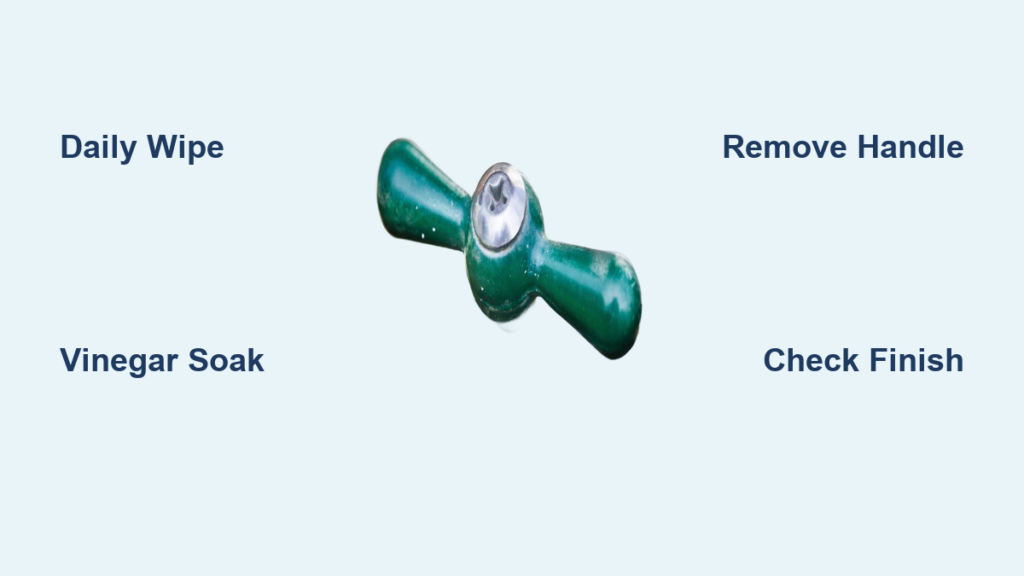
Look for a small red (hot) or blue (cold) plug on the top or side of the handle. Some feature H and C labels instead. Use a flathead screwdriver or fingernail to gently pry it off without scratching the finish.
• A hexagonal socket means you need an Allen wrench (typically 3/32″ or 1/8″)
• This design is used by Moen, Delta, Kohler, and American Standard
Inspect for a Direct Screw
Flip the handle over or check the base. If you see a Phillips or flathead screw, it is a direct-attach model common in older compression faucets.
Tighten the Set Screw to Fix a Loose Handle

Eight out of ten detached handles simply need a tightened set screw. This fix works if the handle spins or wobbles but the internal mechanism is intact.
Tools Needed
• Allen wrench (3/32″ or 1/8″)
• Small flathead screwdriver
Steps to Reattach
- Remove the decorative cap using the flathead screwdriver.
- Insert the correct Allen wrench into the hex socket.
- Loosen the screw slightly if it is stuck.
- Slide the handle fully onto the valve stem by pushing until it seats completely.
- Tighten the screw clockwise until snug.
- Do not over-tighten as this can strip threads or crack plastic.
Warning: Over-tightening is a common mistake. Stop when resistance increases. Snug is enough.
Realign the Handle If Needed
If the faucet does not shut off fully or the handle points the wrong way, slightly loosen the set screw. Rotate the handle to the vertical off position. Ensure red or blue aligns with the hot or cold side. Retighten and test the cold and hot flow to confirm full range.
Fix a Broken Tack Weld with Epoxy

If the handle came off and the metal socket inside is loose or separated, the tack weld has failed. This is common in Forious and similar budget brands. Tightening will not help. You need a structural bond instead.
When to Use Epoxy
The metal insert spins inside the plastic handle. The socket pulls out when you try to reattach. The set screw hole is intact but will not hold.
Materials Required
• Two-part metal epoxy (J-B Weld or Loctite Epoxy Metal/Concrete)
• Isopropyl alcohol
• Fine sandpaper or wire brush
• Allen wrench for alignment during cure
Step-by-Step Epoxy Repair
- Remove the handle and set screw.
- Extract the metal socket from the plastic body.
- Clean both surfaces with alcohol to remove grease and mineral deposits.
- Lightly sand the outer surface of the socket for better adhesion.
- Mix the epoxy (equal parts resin and hardener) until uniform.
- Apply only to the outside of the metal socket. Avoid the inner hex hole or splines.
- Reinsert the socket into the handle.
- Insert an Allen wrench through the set screw hole to keep alignment straight.
- Let cure for 6 to 24 hours following product instructions.
- Reinstall on the valve stem and tighten the set screw.
User Confirmed: Super glue failed in a week. J-B Weld lasted over 18 months.
Avoid: Filling the screw hole or letting epoxy seep into functional areas. This ruins future adjustability.
Install a Universal Replacement Handle
When the original handle is cracked, stripped, or beyond repair, a universal faucet handle is the fastest and most reliable solution.
Why Choose a Universal Handle
• Fits most standard valve stems
• Includes built-in set screw
• No glue, no waiting
• Cost: $10 to $20
• Installs in under 5 minutes
Where to Buy
• Home Depot
• Lowe’s
• Amazon
• Local plumbing supply stores
Installation Steps
- Remove the old handle completely.
- Slide the universal handle over the exposed valve stem.
- Align vertically in the off position.
- Tighten the integrated set screw with an Allen wrench.
- Snap on matching cap (red/blue or H/C).
Choose a finish that matches your faucet: chrome, brushed nickel, or oil-rubbed bronze are widely available.
Claim a Free Manufacturer Replacement
Many brands including American Standard, Moen, and Delta offer lifetime warranties on handles even years after purchase.
How to Get a Free Handle
- Take a clear front-facing photo of your faucet as if you are about to use it.
- Visit the manufacturer website or call customer service.
- Submit the photo. They will identify the model.
- Receive a free replacement in 2 to 3 days.
Note: These handles are not sold individually. They are only available through warranty.
For Amazon Purchases
Some brands ship replacements as $0.00 orders. If you do not receive it, check your Amazon order history for a $0.00 item. Contact Amazon Customer Service and invoke A-to-Z Guarantee if needed.
Troubleshoot Common Reattachment Issues
Even after repair, problems can persist. Use this guide to diagnose and fix them fast.
Handle Still Loose After Tightening
Cause: Worn splines, debris, or stripped screw.
Fix:
• Remove handle and clean the valve stem with vinegar
• Inspect internal splines. If rounded, replace the handle
• Try a slightly larger Allen wrench if the screw is stripped
Set Screw Will Not Tighten
Cause: Damaged threads or broken screw.
Fix:
• Use needle-nose pliers to extract a broken screw
• Replace with a new M3 or M4 set screw available at hardware stores
• If threads are stripped, switch to a universal handle
Handle Will Not Seat Fully
Cause: Misalignment, corrosion, or obstruction.
Fix:
• Clean the stem and handle cavity with vinegar or descaler
• Lubricate with plumber’s grease before reattaching
• Ensure full downward pressure during installation
Water Leaks After Repair
Cause: Overtightening damaged internal seals.
Fix:
• Do not overtighten. Snug is sufficient.
• If leaking persists, the cartridge may be damaged. Replace it separately.
Avoid These Unreliable Fixes
Some methods seem convenient but fail quickly under sink conditions.
Super Glue (Cyanoacrylate)
• Brittle bond that cracks under stress
• Degrades in moisture
• Lasts days, not months
Soft Soldering
• Melts under hot water exposure
• Requires high heat, risk of damaging nearby plastic
• Not load-bearing
Use Instead: Two-part metal epoxy putty. It is strong, waterproof, and durable when applied correctly.
Compare Repair Methods by Durability

| Method | Durability | Time | Cost | Best For |
|---|---|---|---|---|
| Tighten Set Screw | High | 5 mins | $0 | Loose handle, intact parts |
| Epoxy Repair | Moderate to High | 24 hrs | $10 | Broken socket, failed weld |
| Universal Handle | High | 5 mins | $15 | Damaged original, no warranty |
| Manufacturer Replacement | High | 3 days | Free | Covered under warranty |
Best Long-Term Solution: Mechanical attachment either original screw or universal handle.
Prevent Future Handle Failures
A little maintenance goes a long way in extending handle life.
Monthly Checks
• Gently wiggle the handle to detect looseness early
• Wipe around the base to prevent mineral buildup
Preventive Habits
• Turn the handle gently. No force is needed.
• Clean the set screw annually by removing, wiping, and reinserting
• Replace worn screws before they strip
Pro Tip: Register your faucet with the manufacturer. This speeds up warranty claims later.
Final Thoughts on Fixing Your Faucet Handle
Fixing a faucet handle that came off is almost always a simple job. Start with tightening the set screw. Most cases resolve in minutes. If the handle is damaged, epoxy can work, but a universal replacement or free warranty part offers better long-term reliability. With basic tools and a little know-how, you can restore full function fast without a plumber. Check your manufacturer warranty before buying parts. You may qualify for a free replacement.
Frequently Asked Questions About Fixing a Faucet Handle That Came Off
Why does my faucet handle keep coming off?
The most common cause is a loose or missing set screw. Over time, the screw that secures the handle to the valve stem can loosen due to repeated twisting, thermal expansion, or vibration. In some cases, the internal socket or splines have worn down, preventing secure attachment.
Do I need to turn off the water to fix a loose faucet handle?
No. Shutting off the water supply is not required for this repair. The fix involves the handle attachment mechanism only, not the valve cartridge or water lines. You can complete the repair with the water still on.
Can I use super glue to reattach my faucet handle?
No. Super glue (cyanoacrylate) creates a brittle bond that fails under moisture and repeated stress. It typically lasts only days. Use a two-part metal epoxy like J-B Weld instead for a durable, waterproof bond that lasts years.
How long does epoxy take to cure on a faucet handle?
Most two-part epoxies require 6 to 24 hours for full cure. Follow the product instructions for specific timing. Avoid reinstalling the handle until the epoxy is fully cured to ensure maximum bond strength.
Where can I buy a universal faucet handle?
Universal faucet handles are available at Home Depot, Lowe’s, Amazon, and local plumbing supply stores. They typically cost $10 to $20 and come in common finishes like chrome, brushed nickel, and oil-rubbed bronze.